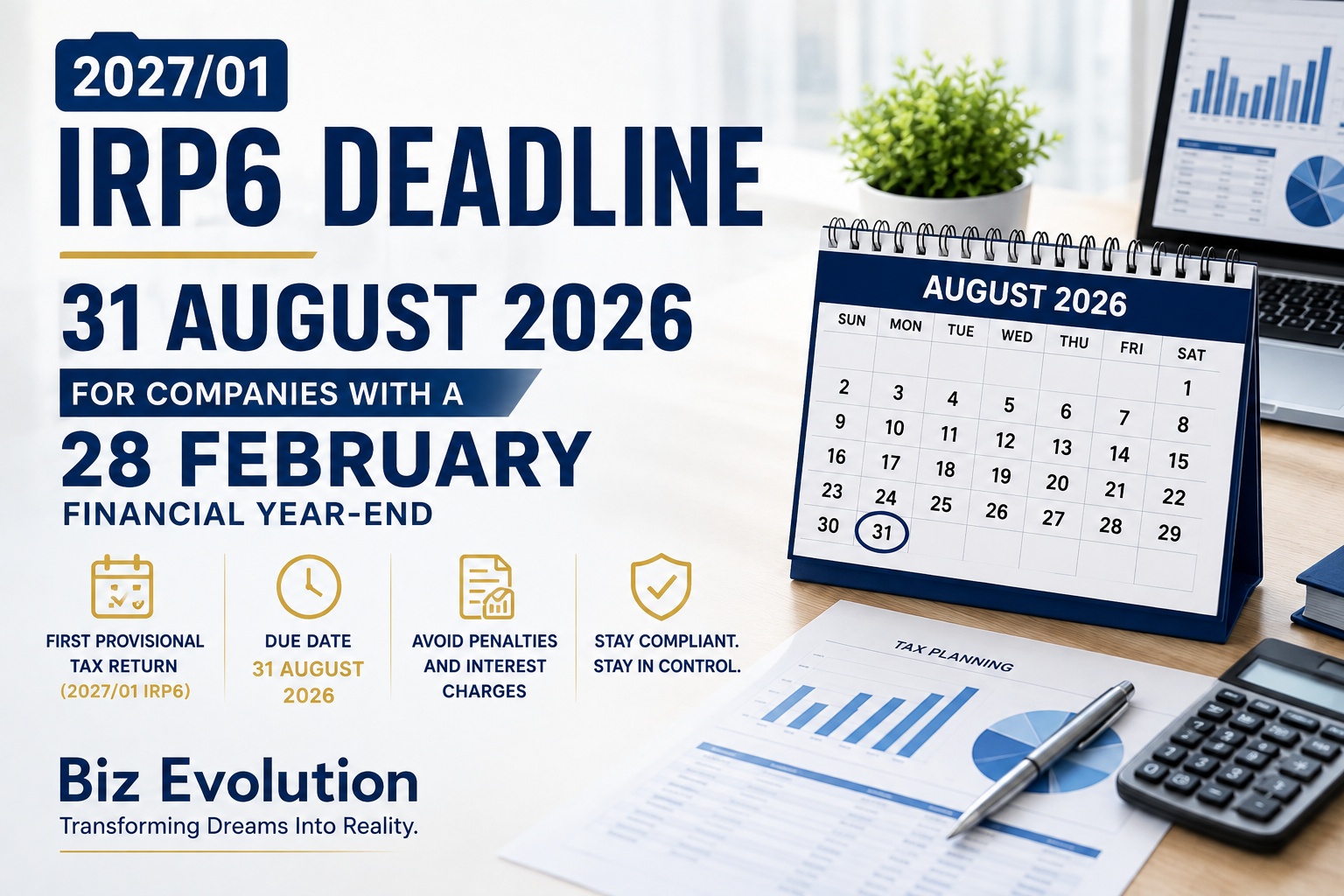
If your company has a 28 February financial year-end, the 2027/01 IRP6 provisional tax return and first provisional tax payment are due by 31 August 2026. Missing this SARS deadline can result in penalties, interest charges, and unnecessary compliance risks, even if your company has not traded during the period.

At Biz Evolution, our registered SARS and SAIT tax practitioners help companies across South Africa prepare and submit IRP6 provisional tax returns accurately and on time. With more than 30 years of combined tax experience, we understand how provisional tax works, how SARS calculates penalties, and how businesses can avoid costly filing mistakes.
This guide explains who must submit the 2027/01 IRP6, what information you need, how the payment is calculated, common errors businesses make, and what happens if you miss the 31 August deadline.
What Is the 2027/01 IRP6?
The IRP6 is the SARS Provisional Tax Return. It allows companies to pay income tax in instalments during the financial year instead of paying the full amount when the annual corporate tax return (ITR14) is submitted.
For companies with a 28 February 2027 financial year-end, the 2027/01 IRP6 is the first provisional tax return for the 2027 year of assessment and covers the period from 1 March 2026 to 31 August 2026.
SARS requires companies to submit an estimate of their expected taxable income for the full financial year and make the first payment towards that expected tax liability.
2027/01 IRP6 Deadline: 31 August 2026
For companies with a 28 February financial year-end, the provisional tax calendar is straightforward:
| Submission | Due Date |
|---|---|
| First Provisional Tax Return (2027/01 IRP6) | 31 August 2026 |
| Second Provisional Tax Return | Last business day of February 2027 |
| Optional Third (Top-Up) Payment | 30 September 2027 |
The 31 August 2026 deadline is compulsory. Any provisional tax payment due must be submitted to SARS on or before this date to avoid penalties and interest.
Which Companies Must Submit an IRP6?
One of the most common misconceptions is that only profitable companies need to file provisional tax returns.
In reality, most companies registered in South Africa are provisional taxpayers unless specifically exempt by SARS.
This includes:
- Private companies (Pty Ltd)
- Close corporations
- Dormant companies
- Companies that made a loss
- Companies that did not trade during the period
- Investment and holding companies
Even if your company has no taxable income, an IRP6 submission may still be required to remain fully compliant with SARS.
Why the 31 August Deadline Matters
The first IRP6 payment is not simply an administrative formality. It forms part of your company’s annual tax obligations and affects your cash flow planning for the rest of the financial year.
Submitting the IRP6 on time helps you:
- Avoid SARS penalties
- Prevent interest on unpaid provisional tax
- Maintain a good compliance record
- Improve cash flow forecasting
- Reduce the risk of a large tax liability at year-end
For businesses applying for tax clearance certificates, tenders, funding, or government contracts, maintaining SARS compliance is especially important.
How Is the First IRP6 Calculated?
The first provisional tax payment is generally based on an estimate of your company’s taxable income for the full financial year ending 28 February 2027.
Example
Assume your company expects:
- Taxable income: R1,000,000
- Corporate income tax rate: 27%
- Estimated annual tax liability: R270,000
The first provisional payment is typically approximately half of the estimated annual tax, which means your 2027/01 IRP6 payment would be around R135,000.
The second provisional tax return submitted at the end of February allows the estimate to be revised and the balance of the expected tax liability to be settled.
What Information Do You Need Before Filing?
Before preparing your 2027/01 IRP6, gather the following information:
- Current management accounts
- Year-to-date income and expenses
- Payroll information
- Asset purchases and disposals
- Capital allowances and depreciation schedules
- Previous SARS assessments
- Prior-year taxable income
- Expected revenue and expenses for the remainder of the financial year
Using accurate financial records is essential because SARS expects companies to submit a reasonable estimate of taxable income.
Common IRP6 Mistakes Businesses Make
Every year we see businesses make avoidable provisional tax errors that lead to penalties, cash flow problems, and unnecessary SARS queries.
Many companies only start preparing their IRP6 a few days before the deadline, leaving little time to review financial information or correct errors.
1. Waiting Until the Last Week of August
2. Using Last Year’s Figures Without Updating Estimates
Business conditions may have changed significantly. SARS expects estimates to reflect the current financial year, not simply the previous year’s results.
3. Forgetting Non-Cash Adjustments
Depreciation, capital allowances, assessed losses, and other tax adjustments can materially affect taxable income.
4. Ignoring SARS Correspondence
Outstanding SARS notices, penalties, or previous assessments should be reviewed before submitting a new provisional tax return.
5. Submitting a Nil Estimate Incorrectly
A zero estimate may be appropriate in some circumstances, but it should be supported by the company’s actual financial position.
Can You Submit a Zero IRP6?
Yes. If your company is expected to have no taxable income for the financial year, a nil estimate may be submitted.
However, a zero estimate should only be filed after reviewing:
- Current financial statements
- Prior-year taxable income
- Expected future transactions
- SARS assessment history
Submitting an unrealistic nil estimate can create complications later in the year.
What Happens If You Miss the 31 August 2026 IRP6 Deadline?
Missing the deadline can have serious consequences.
SARS Penalties
SARS may impose a 10% late-payment penalty on any provisional tax that should have been paid by 31 August.
Interest Charges
Interest accrues on unpaid provisional tax from the due date until payment is made.
Increased Compliance Risk
Late or inaccurate submissions can increase the likelihood of:
- SARS reviews
- Verification requests
- Additional administrative correspondence
- Delays in tax clearance applications
For businesses with multiple tax obligations (VAT, PAYE, UIF, SDL, and corporate tax), missing one deadline often creates a chain reaction of compliance problems.
One of the biggest provisional tax risks is underestimating taxable income.
If the estimate submitted to SARS is significantly lower than the company’s actual taxable income, SARS may impose underestimation penalties in addition to interest on the tax shortfall.
Professional tax planning helps ensure that your estimate is:
- Realistic
- Defensible
- Based on current financial information
- Optimised for cash flow
How Biz Evolution Can Help
At Biz Evolution, we specialise in SARS tax compliance and corporate tax services for South African businesses.
Our services include:
- IRP6 preparation and submission
- Provisional tax calculations
- SARS eFiling assistance
- Corporate income tax (ITR14) returns
- Bookkeeping and management accounts
- Tax planning and cash flow forecasting
- Penalty and interest mitigation
- SARS objections, appeals, and compliance support
Our team of registered SAIT and SARS tax practitioners has over 30 years of combined tax experience, helping companies remain compliant while reducing unnecessary tax risk.
Final Thoughts
The 2027/01 IRP6 deadline on 31 August 2026 is one of the most important SARS compliance deadlines for companies with a 28 February financial year-end. Filing early gives you time to review your financial position, calculate a realistic taxable income estimate, and avoid unnecessary penalties and interest.
Whether your company is profitable, dormant, or still growing, submitting an accurate IRP6 helps protect your cash flow and keeps your business compliant with SARS requirements.
Need help with your 2027/01 IRP6 before 31 August 2026?
Contact Biz Evolution today and let our registered tax practitioners prepare and submit your IRP6 provisional tax return accurately, professionally, and on time.
Biz Evolution – Transforming Dreams Into Reality.
Frequently Asked IRP6 Questions
Yes. For companies with a 28 February 2027 financial year-end, the first provisional tax return (2027/01 IRP6) is due by 31 August 2026.
In many cases, yes. Dormant companies are generally still regarded as provisional taxpayers unless specifically exempt.
SARS may charge a 10% late-payment penalty plus interest on any unpaid provisional tax.
Yes. The estimate can be revised when the second provisional tax return is submitted at the end of February 2027.
No. Provisional tax is a payment mechanism for company income tax. The final tax liability is determined when the annual ITR14 corporate tax return is submitted.