If you’ve ever searched “What is the difference between PAYE, VAT, and provisional tax in South Africa?” — you’re not alone.
Thousands of business owners, freelancers, and even salaried individuals confuse these three key tax types. The result? Missed deadlines, penalties, and unnecessary stress.
In this 2026 updated guide, we break it down simply so you understand:
- What each tax type means
- Who needs to pay it
- When it’s due
- How to stay compliant with SARS
What is PAYE? (Pay As You Earn)
Definition
PAYE is a tax deducted from employee salaries by an employer and paid directly to SARS.
Who must pay PAYE?
- Employers with staff
- Businesses paying salaries or wages
2026 Key Requirements
- Submitted monthly to SARS
- Includes UIF and SDL (where applicable)
- Must be declared via EMP201
Common Mistake
Many businesses fail to submit PAYE on time, leading to penalties and interest charges.
Simple Explanation:
PAYE = Tax on salaries (handled by the employer)
What is VAT? (Value-Added Tax)
Definition
VAT is a 15% consumption tax charged on goods and services in South Africa.
Who must register for VAT?
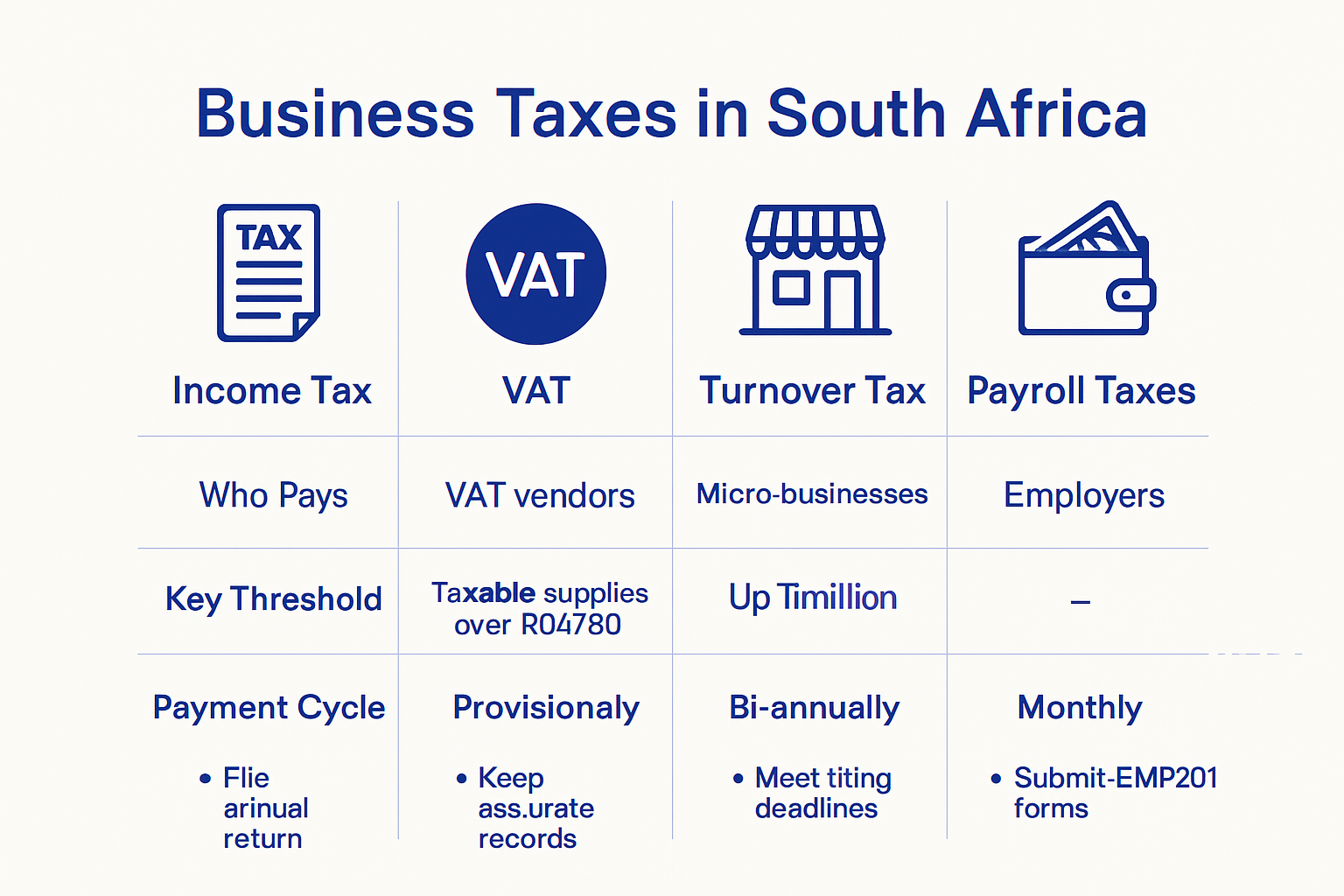
- Businesses with turnover above R1 million/year (mandatory)
- Voluntary registration from R50,000 turnover
2026 VAT Rules
- Submitted every 2 months (bi-monthly cycles)
- Declared via VAT201
- Businesses must track input vs output VAT
Common Mistake
Charging VAT but failing to submit returns or claiming incorrectly.
Simple Explanation:
VAT = Tax you collect from customers and pay to SARS
What is Provisional Tax?
Definition
Provisional tax is advance tax paid during the year to avoid a large tax bill at the end.
Who must pay provisional tax?
- Freelancers
- Business owners
- Individuals earning non-salary income
2026 Provisional Tax Deadlines
- 1st Payment (IRP6): August 2025
- 2nd Payment: February 2026
- 3rd (Optional): September 2026
(Applies to 2025/2026 tax year)
Common Mistake
Underestimating income → resulting in underpayment penalties
Simple Explanation:
Provisional Tax = Pay your tax in advance
| Feature | PAYE | VAT | Provisional Tax |
|---|---|---|---|
| Who pays? | Employer | Business | Individual/Business |
| What is taxed? | Salaries | Goods & Services | Income |
| Frequency | Monthly | Bi-monthly | Twice a year |
| Responsibility | Employer | Business | Taxpayer |
2026 SARS Updates You Must Know
To stay competitive and compliant in 2026, here are key updates:
1. Increased SARS Compliance Monitoring
SARS continues to use AI and data matching to detect:
- Undeclared income
- VAT discrepancies
- PAYE non-compliance
Translation: It’s harder than ever to “slip through the cracks.”
2. Auto-Assessment Changes
- SARS no longer allows simple “accept” without review
- Taxpayers must review and request corrections if needed
3. Stricter Penalties in 2026
- Late submissions = immediate penalties + interest
- Repeated non-compliance may affect:
- Tax Clearance Status
- CSD (Central Supplier Database) compliance
4. Digital-First Filing
- SARS is pushing eFiling and automation
- Manual processes are being phased out
Why Understanding These Taxes Matters
Getting this wrong can cost your business:
- Penalties and interest
- Cash flow problems
- Loss of contracts (especially government tenders)
- SARS audits
Getting it right gives you:
- Peace of mind
- Better financial planning
- Strong compliance profile
- Business growth opportunities
When Do You Need All Three?
You may need to handle all three taxes if:
- You run a business with employees → PAYE
- Your business is VAT registered → VAT
- You earn business profits → Provisional Tax
This is where most businesses struggle — managing all obligations together.
How Biz Evolution Helps You Stay Compliant
At Biz Evolution, we simplify tax compliance so you can focus on growing your business.
We assist with:
- PAYE, UIF & SDL submissions
- VAT registration & returns
- Provisional tax planning & filing
- Tax compliance status & SARS support
With 35+ years combined experience, we ensure you stay compliant and penalty-free.
Stop guessing your taxes. Let Biz Evolution handle your tax — professionally and stress-free.
Frequently Asked Questions about Taxes in South Africa
PAYE is deducted from salaries by employers, while provisional tax is paid directly by individuals earning additional income.
es. Many business owners pay PAYE for employees and provisional tax on their own income.
You may face penalties, interest, and possible SARS enforcement actions.
No. It also applies to individuals earning income outside of a salary.